

The phrase “Ohio EPA compliance” shows up in a lot of grease trap service contracts and on a lot of inspection notices. But most restaurant owners in Toledo have a vague sense of what it means without understanding what the regulation actually requires. This guide goes through the specific code requirements, how they interact with the Toledo FOG (Fats, Oils & Grease) Program, and what you actually need to have on hand if an inspector shows up.
Note: Specific code references, fine amounts, and inspection requirements in this article are provided for general guidance only. Regulations can change — always verify current requirements with the City of Toledo or a licensed compliance professional before making decisions for your business.

The Regulatory Framework: Two Levels
Grease trap compliance for Toledo restaurants operates on two levels simultaneously.
The first is the state level under Ohio Administrative Code 3745-33 — Ohio’s industrial pretreatment rules, which require commercial food service establishments to prevent FOG from entering the public sewer system above acceptable concentrations. The Ohio EPA sets the framework; municipalities implement it.
The second is the local level under Toledo Municipal Code Chapter 923 and the Toledo FOG (Fats, Oils & Grease) Program, administered by Toledo Waterways & Water Services. Toledo has its own FOG ordinance that incorporates the state requirements and adds local enforcement authority — meaning Toledo inspectors can issue notices of violation and fines independently of state enforcement.
In practice, most compliance interactions happen at the local level with Lucas County health inspectors and Toledo Waterways & Water Services staff. State EPA involvement typically only occurs in cases of major sewer overflow events or persistent repeat violations.
What Ohio Administrative Code 3745-33 Actually Requires
The state regulation requires all industrial users (including food service) to:
- Install and maintain pretreatment equipment (your grease trap or interceptor) that prevents FOG discharge above the allowable limit — 250 mg/L for oils and grease in a single sample
- Service that equipment on a schedule sufficient to maintain it below capacity
- Use a licensed waste hauler registered with the Ohio EPA for disposal
- Maintain service documentation available for inspection

What Lucas County health inspectors Actually Check
During a FOG compliance inspection in Toledo, here is what the inspector will typically request and examine:
- Service manifests — the single most important document. These must show the date of service, volume removed, service provider name and license number, and disposal facility
- Service log — a running record of all service dates. Many restaurants keep this as a binder in the manager’s office or a folder in the kitchen
- Trap condition — the inspector may open the trap lid or measure fill level on-site
- Disposal facility documentation — your hauler should be disposing at a facility permitted to receive grease waste in Ohio
- Trap sizing documentation — for older installations, sometimes requested to verify the unit is correctly sized for current fixture count
The single biggest failure we observe among Toledo restaurants isn’t an overloaded trap — it’s missing paperwork. Restaurants that had the work done but can’t produce the manifests are cited just the same as restaurants that didn’t have the work done at all. The documentation is the compliance.
Licensed Haulers: Why It Matters
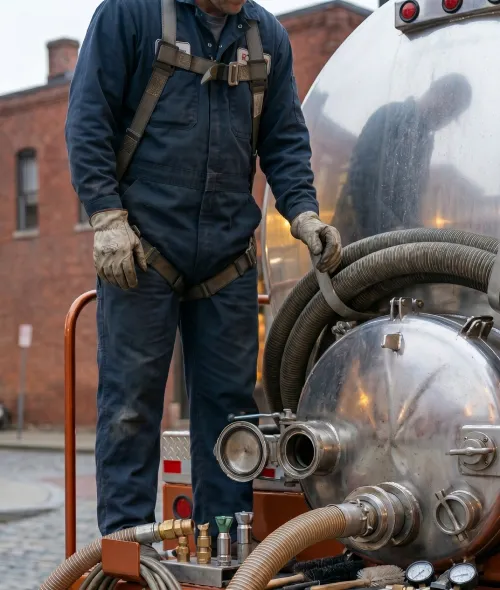
Not every company that offers grease trap service is operating with a fully compliant waste disposal chain. The Ohio EPA requires grease waste haulers to maintain a valid transporter license and dispose of waste at an approved facility. When you hire a service provider, ask for their Ohio EPA transporter license number — a legitimate provider will have it and will include it on your manifest.
We document our license number, disposal facility permit number, and waste volume on every manifest we issue. If your current provider doesn’t produce this level of documentation, that’s a compliance gap for your business, not just theirs.
What Happens During a Violation
If Toledo issues a notice of violation under the FOG program, the standard sequence is:
- Written notice citing the specific violation (missing documentation, overloaded trap, etc.)
- Required response within a specified timeframe — typically 5–30 days depending on severity
- Re-inspection to verify compliance
- If not corrected: administrative fine starting at $250, escalating to $5,000 per violation
- For pattern violations or sewer discharge events: referral to the Ohio EPA, which carries separate enforcement authority
The best outcome from any violation is to respond immediately with documentation that you’ve addressed the issue. Inspectors have discretion on fines for first violations when the restaurant demonstrates prompt corrective action.
Frequently Asked Questions
Staying compliant starts with a clean system. Toledo Grease Trap provides grease trap cleaning and pumping services with service records you can show inspectors. Call (419) 318-6433.
Ask for their Ohio EPA transporter registration number directly. You can also verify hauler licenses on the Ohio EPA’s website under the industrial waste transporter registry. A compliant service provider will list this information on every waste manifest they issue.
The Lucas County Health Department coordinates food service licensing with FOG compliance status. While grease trap inspection is not always a formal prerequisite for license renewal, FOG violations on record can affect licensing outcomes. Maintaining clean FOG records is the cleanest path through any regulatory interaction.
Under both Ohio Administrative Code 3745-33 and Toledo Municipal Code Chapter 923, the discharge limit for fats, oils, and grease is 250 mg/L for a grab sample or an average of 100 mg/L for multiple samples. A properly maintained grease trap will keep discharge well below this threshold.
Yes. Mobile food units generating FOG are subject to the same pretreatment requirements as fixed establishments. Most food truck operators address this by disposing of grease waste through a licensed commissary kitchen facility that holds the required permits.
Toledo FOG program requirements specify a 3-year retention period for service manifests and logs. Ohio EPA pretreatment requirements for industrial users also specify 3 years. Keep all manifests dated and filed by facility — digital backup copies are acceptable, but the original signed manifests should be retained.
Related Articles
- Toledo FOG Program Explained for Restaurant Owners
- How Often Should Toledo Restaurants Clean Their Grease Trap?
- 5 Warning Signs Your Grease Trap Needs Emergency Service
We Service the Entire Toledo Area
We cover Maumee, Perrysburg, Oregon, Waterville, Bowling Green, Findlay and the greater Toledo, OH area.